


Midtown East Introduction

Midtown East is a mature mixed-use residential and commercial district in Manhattan, distinguished by its prominent landmark resources. The neighborhood is anchored by Grand Central Terminal and the Park Avenue corporate corridor, while areas such as Turtle Bay, Sutton Place, and Beekman Place offer quiet, refined residential communities. Major Fortune 500 companies, including JPMorgan Chase, Morgan Stanley, and Bloomberg, have a presence in the area. Compared with the more tourist-heavy core of Midtown, Midtown East offers a more elegant and residential atmosphere, while allowing residents to walk to Manhattan’s major business districts, cultural landmarks, luxury shopping destinations, distinctive dining options, and multiple subway lines.

Midtown East offers some of the strongest transportation access in Manhattan. Grand Central–42 St connects residents to the 4, 5, 6, 7, and S subway lines, Metro-North Railroad, and LIRR service through Grand Central Madison. Additional nearby stations such as 51 St, Lexington Av/53 St, and Lexington Av/59 St provide access to the 6, E, M, N, R, W, 4, and 5 trains, making commuting to Downtown Manhattan, the Upper East Side, Queens, Brooklyn, and regional suburbs highly convenient.

Midtown East is part of NYC Geographic District 2 and offers access to several well-known public school options. P.S. 59 Beekman Hill International on East 56th Street serves Pre-K through 5th grade, while East Side Elementary School, P.S. 267 on East 63rd Street serves kindergarten through 5th grade. Families may also look at nearby District 2 and citywide options.


Midtown East offers a convenient but more refined urban lifestyle. Residents have easy access to grocery stores, restaurants, cafés, pharmacies, fitness studios, medical offices, and professional services, while Grand Central Market, nearby office retail, and East Side dining corridors make the neighborhood practical for both weekday routines and after-work life.

Midtown East’s identity is shaped by architecture, diplomacy, business, and classic Manhattan institutions. Landmarks such as Grand Central Terminal, the Chrysler Building, the Seagram Building, St. Patrick’s Cathedral, and the United Nations area give the neighborhood a formal and international character. Its mix of office towers, historic buildings, residential co-ops, and luxury condos creates a neighborhood that feels both business-oriented and quietly residential.
The Grand Central area, the Park Avenue office corridor, and the nearby Fifth Avenue retail district anchor Midtown East’s commercial activity. The neighborhood combines corporate offices, luxury shopping, restaurants, cafés, hotels, and daily services, serving residents, office workers, commuters, and visitors. Its mix of business, retail, and convenience-oriented services gives Midtown East a polished and highly functional Manhattan commercial environment.
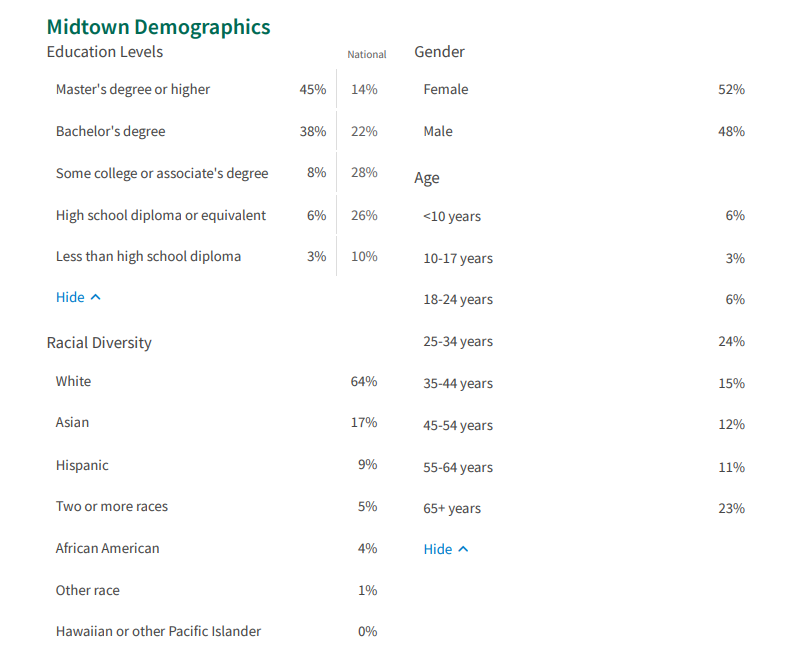

Midtown East draws from Midtown’s highly educated and high-income resident base. Niche reports Midtown’s population at 71,366, with 60% of residents renting and 40% owning. The area has a median household income of $178,477, and 83% of residents hold a bachelor’s degree or higher, including 45% with a master’s degree or higher. This profile supports demand from professionals, executives, international residents, long-term Manhattan homeowners, and renters seeking a central but more polished East Side lifestyle.
Midtown East remains highly livable for residents who value convenience, building services, and a more orderly East Side setting, supported by active residential buildings, office security, doorman inventory, and consistent street activity.

For buyers, Midtown East offers a high-value ownership market shaped by luxury condominiums, established co-ops, full-service buildings, and a strong resale base. In 2025, Midtown East recorded 103 sales, with a median sold price of $2,515,000, an average sold price of $4,249,664, and an average sold price per square foot of $2,354. Resales represented 83.5% of recorded sales, while new development accounted for 16.5%, showing that the market is heavily supported by established residential inventory and selective luxury products.


For renters, Midtown East remains a premium Manhattan rental market supported by full-service buildings, strong transit access, and proximity to major office and institutional corridors. In 2025, the neighborhood recorded 214 active rentals and 149 rented units, with an average listed rent of $11,070 and a median listed rent of $6,075. One-bedroom and two-bedroom homes made up the largest share of rented units, while larger luxury apartments pushed the overall average higher.
The area is especially suitable for professionals working around Grand Central, Park Avenue, Lexington Avenue, and the United Nations area, including employees in finance, consulting, law, media, diplomacy, and healthcare. It also works well for students, researchers, and medical professionals commuting to nearby institutions such as Baruch College, Hunter College, Fordham Lincoln Center, Weill Cornell Medicine, and Rockefeller University, offering central Manhattan access with a more residential East Side feel.

Midtown East continues to hold long-term investment appeal through its central Manhattan location, strong transit access, high-income resident base, and demand for full-service housing. In 2025, the neighborhood recorded 264 active sales, with a median listed price of $3,312,500 and an average listed price per square foot of $3,017. With both established resale inventory and selective luxury new development, Midtown East remains a competitive East Side market where ACRE’s local insight, pricing analysis, and brokerage experience can help buyers, sellers, renters, and investors evaluate opportunities more effectively.

Midtown East stands out as a polished, central Manhattan neighborhood that balances business access, residential comfort, luxury housing, strong transportation, and classic New York architecture. For buyers, it offers established co-op and condominium inventory with long-term Manhattan value; for renters, it provides convenience, full-service buildings, and access to major employment centers. Overall, Midtown East appeals to residents who want a central location without giving up a more refined and residential East Side living experience.


Comments